
23 learnings on building community and holding space
re-composting learnings from failure, utopia, and everything in between

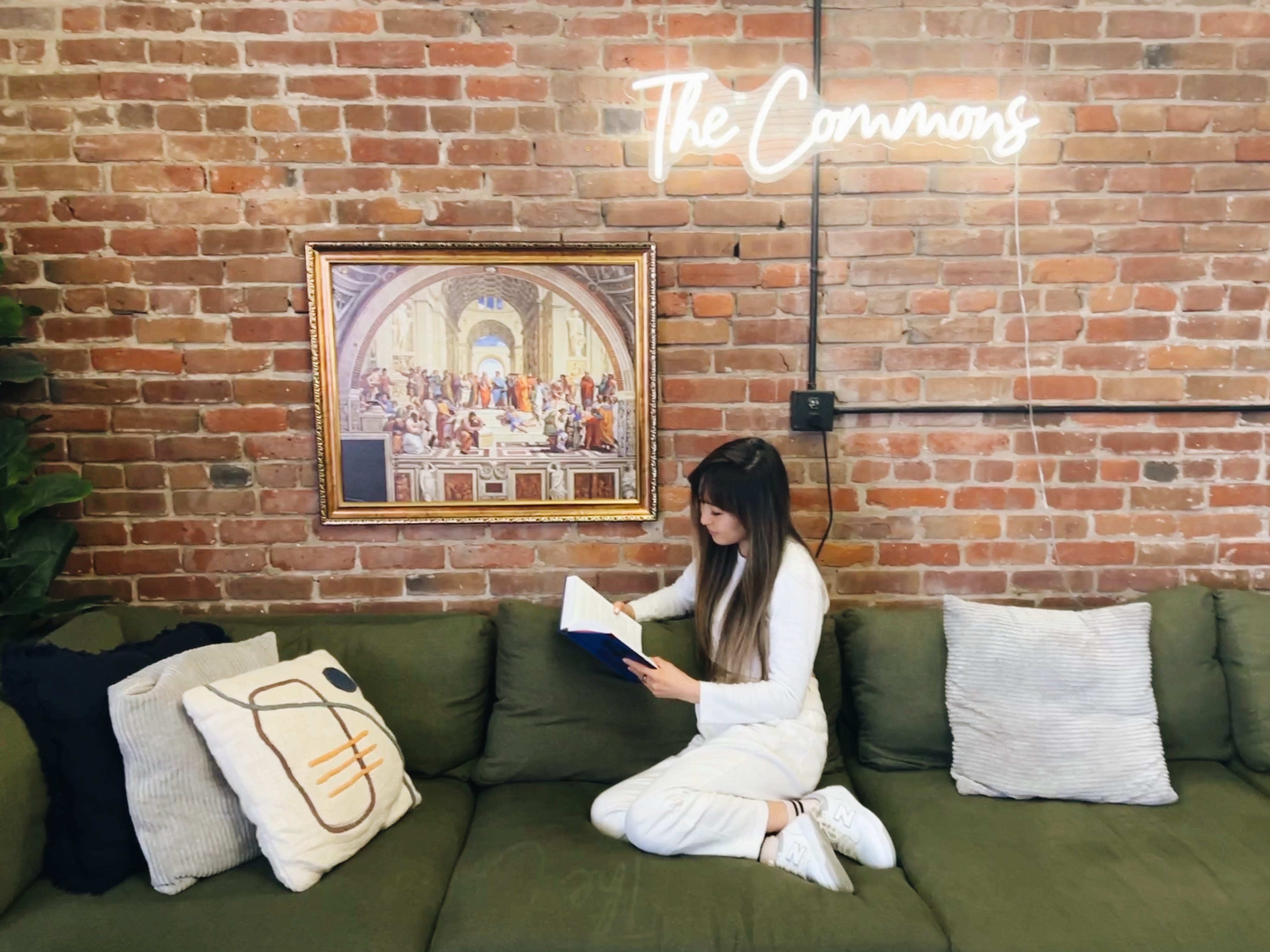
There’s something in my soul blueprint that loves to hold space. Particularly spaces that transition people from horizontal, sequential time, into vertical, liminal, no-time.
In this in-between, we have the opportunity to be with what is true, the ten thousand expressions of the all. Waiting for us to drop the show, in order to be shown what is just beyond the wispy veil. Between the threshold of stale scripts and aliveness, I’ve striven to take the vow of guardianship and fellow friend.
Over the past decade, I’ve held a variety of spaces in all kinds of shapes and sizes - from online philosophy salons to pluralistic dialogues, from rabbit hole transmissions to mystical sunday services, from retreat design to physical community spaces like The Commons.
Today i’m attempting to share a handful of the learnings i’ve accrued over the years, re-composting them back into the universe, from where they came.
These learnings are in no measure perfected and are still making their way through me, changing me. They come in both the aftermath of much failure and confusion, and also alongside experiences wherein heaven briefly flickers her perfection and knowing smile, before returning back to the froth.
Take what is useful, and leave the rest.
Here are 23 learnings about building community and holding space, with elaborations below:
You are not creating a community or holding a container from nothing: you are becoming a vessel for something that already wants to exist.
Your community will faithfully mirror your unexamined interior.
Coherence is the only qualification that actually matters.
You will become everyone’s mother and father whether you want to or not.
Community is a thousand one-on-ones, not one big warm room.
Your first 100 people are the community’s energetic constitution.
A scene is not a community: knowing the difference and designing accordingly.
Build concentric circles, not open doors: the architecture of belonging
The sacred balance: designing for masculine and feminine
You cannot ask for transcendence from a nervous system that hasn’t yet landed.
Prepare thoroughly, then throw away the map when you walk through the door.
Light structure is what makes deep emergence possible.
Beauty is not aesthetic: it’s a survival technology.
Opening is only half the ceremony: integration is the other half of the work.
The container is a mirror, not a destination: on deity yoga and the holder’s real job.
Some third thing is created, when the group cohere’s deeply enough.
Friendship is a byproduct of shared pursuit, never a goal in itself.
What you celebrate becomes what you are: choose with extraordinary care.
What your community doesn’t talk about shapes it as much as what it does.
The faustian bargain of manufactured intimacy and what the body remembers.
The most dangerous moment in a community’s life is after its first success.
Distributed leadership is biological necessity, not democratic ideal.
Putting yourself out there is half of the battle. Skillful “self-promotion” is in service to the most beautiful world your heart knows is possible and the people you’re meant to build it with.
the builder’s interior.
1. You are not creating a community or holding a container from nothing: you are becoming a vessel for something that already wants to exist.
Across the history of human thought, creation was often intuited less as invention than as discovery. Plato called it the eidos, the eternal Forms of which every material thing is an instantiation; the Vedic tradition called this the Akasha, the primordial field in which all possible forms exist as latent potential awaiting the conditions that will draw them into manifestation.
As such, the mathematician does not invent the theorem, she uncovers it; the poet does not manufacture beauty, he becomes transparent enough that beauty moves through him. And so the community builder is making themselves available to a social egregore that already wants to exist, waiting for a sufficiently coherent and willing vessel through which to enter the world.
Instead of words, paint, or mathematical proofs - the community builder communicates the transmission via energetic, somatic, and relational language. Essays can point, books can describe and platforms can distribute, but only lived human contact actually transmits wisdom, through limbic resonance, mirror-neuron empathy, and the quiet contagion of a regulated, inhabited body meeting another, which may be the oldest technology we have and the one we most need to remember now.
2. Your community will faithfully mirror your unexamined interior.
The field holder who hasn’t metabolized their need for approval will unconsciously build a culture where dissent feels dangerous; the holder who hasn’t made peace with their own authority will either over-assert or chronically under-lead, leaving the community perpetually anxious about who’s steering.
This is the nature of projection at scale, and what you create will faithfully be a map of your interior. The parts of yourself you haven’t visited will show up as the recurring conflicts you can’t seem to fix, no matter how many structural redesigns you attempt.
The invitation isn’t to be perfectly healed before you build (because no one is) and the building is itself part of the healing. The invitation is to maintain a practice of radical self-inquiry running parallel to the community work, always asking: what is this situation showing me about something unresolved in me?
Perhaps the most effective community builders aren’t the most charismatic or the most visionary, but rather the ones most willing to be genuinely disturbed by what their creation reveals about them, and to use it as a crucible for transformation.
3. Coherence is the only qualification that actually matters.
You can give someone the entire community playbook, the perfect event arc, the facilitation techniques, the best rituals, and none of it will matter as much as whether the person holding the container is actually in it, whether what they’re holding reflects their deepest truth, whether the thing they’re doing on Friday night is the same thing their soul is doing at 3am.
The ceiling of any community or container is set not by the format but by the internal coherence of the holder, and the deepest service you can offer is to keep doing your own work to be in alignment. Tend that first. People can feel it, whether unconsciously or consciously
4. You will become everyone’s mother and father whether you want to or not.
The moment you hold space for a group of people, you become a screen onto which they project everything they’ve ever felt about authority, belonging, and love.
Everyone’s first community was their family and those early imprints don’t disappear in adulthood so much as go underground, surfacing reliably every time someone enters a container that is being held by another.
The untrained holder collapses into this dynamic or hardens against it. Instead how might you see the projection clearly, not take it personally, and gently, persistently, return people to their own inner authority.
the foundation.
5. Community is a thousand one-on-ones, not one big warm room.
We often romanticize the crowd, imagining community as a buzzing, alive whole, a room full of people who belong to something together.
But what looks like community from the outside is almost always, on the inside, a web of one-on-one, two-to-one, three-to-three relationships. It starts with 1 person you genuinely want to see again, who pulls in someone they love, and those two find a third, and from that small constellation a culture begins to crystallize.
Which means your job as a space holder isn’t to engineer group cohesion but to create the conditions by which one-on-ones can crystallize, over and over, until the web holds itself.
6. Your first 100 people are the community’s energetic constitution.
A pendulum is an energy structure created by groups of people directing their thoughts and feelings toward the same idea - the more people feed it, the stronger it swings, until it develops a gravitational pull and attracts new participants almost on its own accord.
Every genuine community has an invisible pendulum at its center, a high ideal, a shared longing, a particular quality of aliveness, and your job in the early days is not to grow. Your job is to find the people who will charge that pendulum unconditionally, not because it benefits them, but because they are it.
They are not necessarily the loudest or the most networked. They're the ones who show up early and stay late, who feel the vision in their body not just their head, who would build this even if no one was watching. The early container's energetic signature comes almost entirely from this cohort, which is why who they are is what you're building.
7. A scene is not a community: knowing the difference and designing accordingly.
A scene is a collection of people who frequent the same spaces, share aesthetic sensibilities, and recognize each other at parties. It has genuine value as scenes have birthed some of the most important cultural movements in history, but it should not be confused with community.
The distinction is this: a scene is organized around identity and affiliation, while a community is organized around mutual commitment to something beyond individual identity. In a scene, you’re there because of who you are and who you’re seen to be. In a community, you’re there because of what you’re reaching for together and what you’ve agreed to offer each other in the reaching.
The practical difference is accountability: in a scene, there's no real mechanism by which anyone can hold anyone else to anything, because there's no shared covenant to appeal to, while in a community the shared commitments create the ground for genuine accountability, genuine repair, genuine growth
When you’re building, ask yourself honestly: am i building a community or a scene? The former requires covenant. The latter requires only aesthetics. Both are real but only one will produce the depth you probably actually want.
8. Build concentric circles, not open doors: the architecture of belonging
Many great wisdom institutions in human history solved the same problem the same way: not through a binary choice between open and closed, but through concentric rings, each with its own level of depth, commitment, and access.
The Eleusinian Mysteries of ancient Greece, the Sufi orders, the Catholic sacramental structure, the Benedictine novitiate, the medieval guilds - all of these were carefully tiered systems in which the outer rings were genuinely public while the inner teachings were reserved for those who had demonstrated, over time, the readiness to receive them.
Thus, the tension between openness and exclusivity is not a problem to be solved but a polarity to be held. A purely closed community calcifies, losing the vital influx of new perspectives that keeps any living system from becoming a museum of its own past, while a purely open community dilutes, the depth that made the community worth joining evaporating into pleasant but shallow sociality. The practical architecture looks more like this:
outermost ring: genuine openness, public programming, the community’s gifts transmitted freely to the broader culture
moving inward: increasing commitment, increasing depth, increasing selectivity based not on status or aesthetics but on demonstrated resonance with the community’s actual values.
the innermost ring: the flame itself and “field holders” who most embody the community’s values, paired with skin in the game. Protecting this core is not elitism but rather stewardship of the thing that makes everything else possible.
9. The sacred balance: designing for masculine and feminine
Every community is a universe in miniature, and beneath the surface it is always negotiating the same primordial relationship that wisdom traditions have named again and again, not as a story about men and women, but as the two fundamental modes through which reality organizes itself.
Call them Masculine and Feminine, Yin and Yang, Logos and Eros, Shiva and Shakti, but what matters is the pattern: the masculine is structure, direction, clarity, initiation, boundaries, the focused beam and the container wall, while the feminine is receptivity, emergence, intuition, nurturance, the field that can hold contradiction, the womb-like darkness of potential.
These are not opposites negotiating a truce, but rather complements seeking wholeness, and every institution carries a signature ratio you can feel in its pathologies, because too much masculine may become rigidity, speed over depth and competition, while too much feminine may become drift, endless process, and conversations that never crystallize into decision or form.
The design challenge is not to pick a fixed balance but to build responsive balance, an internal immune system that senses when the energy has tipped too much in either direction and knows how to course-correct.
When these two principles are in genuine dialogue rather than suppressed or overrun, something alchemical happens, and the space becomes self-generative because it begins to function as a microcosm of the cosmos itself.
the craft of holding space.
10. You cannot ask for transcendence from a nervous system that hasn’t yet landed.
You can’t invite people into genuine collective depth if their nervous system is still scanning the room for threat, still asking if it is safe here and if it belongs. If you launch immediately into the beautiful and the profound without first helping people cross the threshold from out-there to in-here, you will be speaking to bodies that cannot yet root, in order to soar. Acknowledge the gap, help people move into their bodies, and design icebreakers that connect people first to themselves, then to one another.
11. Prepare thoroughly, then throw away the map when you walk through the door.
You memorize the arc, review the talking points, know the sequence so deeply it lives in your body rather than your mind, and then, when the first person walks through the door, you release all of it.
Not because it doesn’t matter but because the map is never the territory, and the territory is always more interesting than anything you planned at your desk the night before. The paradox of great facilitation is that the more thoroughly you’ve prepared, the more freely you can abandon the preparation, and the structure becomes scaffolding that holds the space while you disappear into genuine contact with the room.
People feel this distinction immediately, even when they can’t name it. They’re not, ultimately, trying to feel you: they’re trying to feel the transmission, the frequency, the quality of truth and aliveness that your presence is either conducting or blocking.
12. Light structure is what makes deep emergence possible.
Nature does not over-choreograph. A forest is not managed into beauty, it’s given conditions and then trusted, and the most alive things in existence arise from the exquisite tension between just enough structure and just enough freedom.
Many events err toward control, a schedule segmented into 15-minute blocks, a sharing circle that moves left to right with the reliability of a conveyor belt, an organizer who fills every silence before it’s finished breathing, and the result is a gathering that feels like a meeting.
Energetically, the sequential circle is a perfect example: when you know your turn is coming and you’re 3 people away from having to speak, you stop listening and start composing, and the presence that genuine sharing requires gets replaced by performance anxiety and rehearsal.
Try instead an energetic center: an open middle. This can be embodied as an invitation to speak when something genuinely moves you to speak. The genuine intelligence of the group finding itself in real time. This is emergence, and it’s almost always more beautiful than what you planned. Light structure is structure so well-designed it becomes invisible, a riverbank that gives the water somewhere to go without pretending to control how it moves and where it goes.
13. Beauty is not aesthetic: it’s a survival technology.
Beauty is nature’s mechanism for ensuring that what matters gets tended: we protect and adorn what we love, and we love what is beautiful.
When a space holder brings real beauty into their container that arises from deep care and intention for every detail, they’re activating an ancient human instinct that tells the nervous system it has arrived somewhere real. People feel that this was tended, that someone cared enough to make this beautiful, and therefore this matters, and therefore I matter here.
Elaine Scarry argues that beauty creates a condition of acute attention that is the prerequisite for both ethical life and genuine perception. In a community context, this means that the beauty of your space isn’t incidental to the depth of your programming - it’s structural.
14. Opening is only half the ceremony: integration is the other half of the work.
Most events pour everything into the opening, the arrival, the activation, the peak, and then let people trickle out into the night still buzzing and open.
The closing of a gathering deserves its own ritual gravity. This might look like a harvest circle, each person naming one thing that landed, one thread they’re carrying home, one question that opened in them that they didn’t have before, etc.
This transitions an event from a single experience into a process which communicates to people that what happened between them wasn’t entertainment but genuine inner work, and that the community exists not just for the peak but for the long, unglamorous, beautiful arc of becoming.
what emerges.
15. The container is a mirror, not a destination: on deity yoga and the holder’s real job.
In the many religious traditions, deity yoga is the practice of meditating on a teacher/symbol that acts as a conceptual overlay of a certain pattern of energy. It is not so much an all-powerful external being to worship, but a symbol of a particular quality of consciousness so the human mind can recognize it and eventually become it.
Every community or event holder is unconsciously doing a version of this when they build a space with enough coherence to emanate a certain pattern of energy. The point is that what people are recognizing in your field is themselves: their longing when they encounter what you’ve built is their own depth calling to them through the temporary mirror of your presence or field.
So the art is to hold the field strongly enough so that people can step into it and taste who they actually are. And then it is to turn them back towards themselves to stabilize the interior source of that phenomenological shift. A truly successful container is when its members can generate the field the container elicited from them without you, and without the container.
16. Some third thing is created when the group cohere’s deeply enough.
There is something that can happen in a gathering where the collective stops being a collection of individuals and becomes something else entirely. A third thing that feels like a presence that feels distinct from any single person in the room and yet is somehow composed of all of them.
Ancient traditions called this an egregore, a thoughtform, a living field of collective consciousness that arises when enough people direct their attention and intention toward the same frequency. The Collective Presencing tradition calls it the group “tuning,” a process of attentional convergence where the separate signals of individual minds begin to phase-lock into a shared field.
What emerges from that field are revelations and insights that seem to come from the middle of the room rather than from any particular mouth.
Your job as holder is to know this is possible, create the conditions for it, and not waver when it does arrive.
17. Friendship is a byproduct of shared pursuit, never a goal in itself.
Aristotle identified 3 forms of friendship, with the highest, philia, arising not from what people get from each other but from a shared orientation toward what is good, true, and beautiful.
What these traditions understood is that this quality of friendship cannot be manufactured directly: it’s always a byproduct of a shared pursuit of goodness, beauty, and truth, that is larger than the friendship itself. This is why “we’re here to make friends” is one of the least effective things a community or container can say.
The pressure to connect, named explicitly and frontloaded, creates exactly the kind of self-conscious social performance that genuine connection has trouble emerging from. Instead of orienting people toward one another, orient them towards the fire they are tending together. Building the community around a genuine shared pursuit, the exploration of the soul, the practice of a craft, the making and becoming of something together.
People who are reaching toward the same light inevitably find each other in the reaching.
the harder truths.
18. What you celebrate becomes what you are: choose with extraordinary care.
Every community has rituals of celebration, explicit or implicit, that function as a constant transmission of what the community actually values. What is praised, rewarded, highlighted, held up as exemplary is the community’s real value system regardless of what the stated values say.
Communities that celebrate transformation over performance, repair over perfection, consistency over brilliance, generosity over charisma. These are communities whose culture gradually comes to embody these values because the members are being shaped, through repeated ritual acknowledgment, toward them.
Think about what you mark and what you let pass unmarked. The things that go uncelebrated are the things the community will slowly stop doing.
The same goes for what and how you penalize.
19. What your community doesn’t talk about shapes it as much as what it does.
Every community has a shadow: a collection of topics and dynamics that are implicitly off-limits, that nobody explicitly forbids but everybody somehow knows not to raise.
Jung called this the personal shadow, and communities have collective shadows that operate by exactly the same mechanism: they organize in the field as an underground current, felt by everyone, named by no one, slowly shaping the community’s culture in directions nobody consciously chose.
The health of a community can be measured, with startling precision, by its capacity to name its own shadow, to bring into explicit conversation the things that are most uncomfortable to say.
20. The faustian bargain of manufactured intimacy and what the body remembers.
There is a particular kind of event that's proliferated in certain conscious community spaces: the vulnerability accelerator, the intimacy intensifier, the sharing circle designed to take strangers from zero to soul-exposed in 90 minutes. The intentions are almost always genuine, the experiences can feel profound, and yet something about the model reveals a subtle violence hidden inside its apparent care.
Human intimacy was not designed to be a straight shot: it’s a slow accumulation built through repeated small encounters, through the gradual discovery that someone is consistent, through the experience of being seen in ordinary moments before you risk being seen in your most tender ones. Trust is not an emotion you can manufacture through clever facilitation. It’s a biological read of pattern over time.
When we engineer rapid intimacy through vulnerability prompts and deep sharing circles with strangers, we’re asking the nervous system to conclude a process it hasn’t been allowed to run, and the nervous system, being honest, knows the difference. The intimacy feels real in the moment because the emotions are real, but the relational infrastructure to hold that intimacy doesn’t yet exist, so when the event ends and the group disperses and the connection doesn’t sustain, the body registers something it can only interpret one way: i opened, and then i was left.
This is the neurological aftertaste of what might be called intimacy porn, short-term intensity that mimics depth without building the underlying structure that makes depth sustainable.
21. The most dangerous moment in a community’s life is after its first success.
Before success, the community is held together by necessity and shared struggle, the energy lean and genuine; then something shifts, the community gets written about, reaches critical mass, and a new kind of person begins to arrive, not the pendulum holders who came to charge the field but the ones who come because the field is already charged and they want proximity to it. (See Geeks, MOPs, and sociopaths essay)
This changes the energetic composition in ways that, if unattended, will gradually dilute the very thing that made it worth joining. The antidote is to have, by the time success arrives, a cultural immune system strong enough to integrate new energy without losing the essential frequency.
These are values that are behavioral and specific, rituals robust enough that newcomers are shaped by them rather than the other way around, and an inner ring coherent enough that its energetic signature persists even as the outer rings expand. Success is the test of whether you built a culture or just a moment.
22. Distributed leadership is biological necessity, not democratic ideal.
Any system in which all intelligence flows through a single node is, by definition, fragile. One departure, burnout, or loss of coherence in that node and the whole system is compromised. Nature solved this long ago through healthy ecosystems characterized not by centralized control but by distributed intelligence, redundancy, and the capacity of each node to make local decisions in service of the whole without requiring permission from the center. This is the mycelial network, the murmuration of starlings, the immune system - all models of distributed intelligence that are more resilient, adaptive, and creative than any centralized hierarchy could be.
The community builder who understands this invests early and consistently in developing other holders who can genuinely carry and hold the frequency, making consequential decisions from alignment with the community’s deepest values.
This requires the founder to be genuinely willing to share power and credit, to tolerate others doing things differently than they would, to trust that the essential transmission is robust enough to survive multiple different expressions of it.
The communities that outlast their founders are the ones where, by the time the founder steps back, the field is being held by a whole ecosystem of carriers. The goal isn’t to become indispensable. The goal is to become increasingly unnecessary, and to experience that not as loss but as the deepest measure of what you built.
the most beautiful world your heart knows is possible.
23. Putting yourself out there is half of the battle. Skillful “self-promotion” is in service to the most beautiful world your heart knows is possible and the people you’re meant to build it with.
There is a space inside every human heart that knows something, not conceptually, not theoretically, but with the quiet unshakeable certainty of direct perception: it knows what the world could be. It holds a vision of human life lived at its fullest possible expression, of community, of beauty, of the quality of relationship and meaning that we sense is available to us even when every external condition argues otherwise. And it cannot be tarnished.
Every person has this, not a version of someone else’s vision but a unique configuration of the beautiful, shaped by the specific geometry of their particular soul, their particular wounds and gifts and longings, their particular angle of perception on what is missing and what wants to exist.
The diversity of these inner visions is not a problem to be resolved into consensus. It’s the means by which the whole becomes complete.
The purpose of blasting your truest vision into the world is not self-expression for its own sake. Rather, it is recruitment into a co-creation that is larger than any single person can accomplish.
The vision you carry is not yours in the possessive sense. It came through you because your particular instrument was tuned to receive it. However, it belongs to the collective becoming and larger story of what human civilization is trying to grow into. And it will only be fully realized through the convergence of multiple carriers, each bringing their piece, finding each other through the resonance of their shared frequency.
The small gathering matters as much as the large institution or world you’re hoping to channel into this one: the intimate dinner, the living room conversation, the recurring circle of 6 people. This is the transmission itself, happening at the scale that is currently possible, seeding the field with the frequency that will eventually draw in the others who are needed.
Say it clearly enough and the others will find you. They’ve been looking for you as long as you’ve been looking for them.
.
.
.
The Shambhala Warrior Prophecy - A Tibetan Legend
“There comes a time when all life on Earth is in danger. Barbarian powers have arisen. Although they waste their wealth in preparations to annihilate each other, they have much in common: weapons of unfathomable devastation and technologies that lay waste the world. It is now, when the future of all beings hangs by the frailest of threads, that the kingdom of Shambhala emerges.
You cannot go there, for it is not a place. It exists in the hearts and minds of the Shambhala warriors. But you cannot recognize a Shambhala warrior by sight, for there is no uniform or insignia, there are no banners. And there are no barricades from which to threaten the enemy, for the Shambhala warriors have no land of their own. Always they move on the terrain of the barbarians themselves.
Now comes the time when great courage is required of the Shambhala warriors, moral and physical courage. For they must go into the very heart of the barbarian power and dismantle the weapons. To remove these weapons, in every sense of the word, they must go into the corridors of power where the decisions are made.
The Shambhala warriors know they can do this because the weapons are manomaya, mind-made. This is very important to remember, Joanna. These weapons are made by the human mind. So they can be unmade by the human mind! The Shambhala warriors know that the dangers that threaten life on Earth do not come from evil deities or extraterrestrial powers. They arise from our own choices and relationships. So, now, the Shambhala warriors must go into training.
How do they train?” I asked.
“They train in the use of two weapons.”
The weapons are compassion and insight. Both are necessary. We need this first one,” he said, lifting his right hand, “because it provides us the fuel, it moves us out to act on behalf of other beings. But by itself it can burn us out. So we need the second as well, which is insight into the dependent co-arising of all things. It lets us see that the battle is not between good people and bad people, for the line between good and evil runs through every human heart. We realize that we are interconnected, as in a web, and that each act with pure motivation affects the entire web, bringing consequences we cannot measure or even see.
But insight alone,” he said, “can seem too cool to keep us going. So we need as well the heat of compassion, our openness to the world’s pain. Both weapons or tools are necessary to the Shambhala warrior.”
-- Joanna Macy
Beautiful post! You articulated so much of what my journey has been hosting reading groups for the past 2 years. Especially the tension between holding a container while being inevitably transformed by it. Being generous and transparent while also being the person planning, maintaining, and understanding the limits of the structure.
really loved this, thanks for writing!!